We cannot help Jesus repair the world and build the true house of the Lord if we remain fascinated with the violent ways of David the warlord. It's David the worshiper that God makes his covenant with, not David the warlord. The warlord cannot build the house of the Lord. It's David's peaceable Son who builds the true temple. —Brian Zahnd
Do You Identify More with the Lion or the Lamb?
When it comes to prophetic symbolism representing Jesus, two images stand far above the rest: the lion and the lamb. Which image do you most identify with? Which image most excites you? For me, it was easy — I loved the Lion of the tribe of Judah all the way. I adored everything about the imagery — the majestic mane, the large claws, the roar, the sharp teeth, all of it. I had an appreciation for the lamb too; after all, it was the lamb that took away the sin of the world. But now that the lamb has been crucified, resurrected, and ascended, are we not living in the age of the lion? Right?
Is Jesus alluded to as a lion? Certainly. When you examine Genesis 49:8-12, what do you envision for this descendant of Judah? He will receive praise from all. He will embody the strength of a lion, ruling over all peoples and crushing His enemies. Even His brothers will bow down to Him in reverence. His kingdom will be eternal, unchallenged by any other, and all nations will eventually bring tribute and worship before Him. He is the one to whom all nations owe obedience. Pair these thoughts with the imagery John penned in Revelation 5:5: "Stop weeping; behold, the Lion that is from the tribe of Judah, the Root of David, has overcome" (NASB).
Is Jesus alluded to as a lamb? Certainly. John the Baptist publicly declared in John 1:29, "Behold, the Lamb of God, who takes away the sin of the world!" John echoes the same declaration a little later when he encounters Jesus publicly. The prophet Isaiah declared lamb imagery, reflecting the crucifixion, hundreds of years before the incarnation had occurred when he said in Isaiah 53:7, "He [Jesus] was oppressed, and he was afflicted, yet he opened not his mouth; like a lamb that is led to the slaughter, and like a sheep that before its shearers is silent, so he opened not his mouth."
There's no way around it; Jesus is both the Lion and the Lamb. But how do we identify with both of these images and the tension they represent? The first challenge we face is how not to impose our own expectations on either image. When we behold the lion imagery, we must resist defaulting to a great apex predator that tears its enemies to pieces. Similarly, when we contemplate the lamb imagery, we must resist defaulting to simply a weak and defenseless pet. Again, both images are true of Jesus, but it is His image and not our own projections of it that should define Him.
I believe one of the clearest ways to see the images at rest together is found in John's prophetic vision in Revelation 5:5-6:
And one of the elders said to me, "Weep no more; behold, the Lion of the tribe of Judah, the Root of David, has conquered, so that he can open the scroll and its seven seals." And between the throne and the four living creatures and among the elders I saw a Lamb standing, as though it had been slain.
In this vision of Jesus Christ, we behold the lion and the lamb, but it's worth noting that John only heard the decree that the lion was present, yet he only saw a lamb, as though it had been slain. What do these images mean?
The Lion conquers as the crucified Lamb. This is who God has always been.
Jesus, being the Lion of the Tribe of Judah, represents His authority. It's true that His kingdom will be eternal, and all nations will bow their knee and declare that He is Lord. But how is this accomplished? Unbelievably, and contrary to our default methodology of violence, the Lion rules by being a slaughtered Lamb. The King of kings lays down His life and baptizes the world with other-centered, self-sacrificial agape to demonstrate the essence of His Kingship. The Lion conquers as the crucified Lamb. This is who God has always been.
My Kingdom Is Not of This World
I want to make one more point in this chapter concerning the Godhead's non-violent way when it comes to our desire for power and empire-building. Jesus had a couple of very specific moments just before His crucifixion to speak to our perceived need for violence to defend ourselves or, at the very least, to defend Him: Peter cutting off the ear of Malchus and the conversation between Jesus and Pilate. The first example speaks to our personal need to take up arms to defend ourselves and others. The second example speaks to the temptation of marrying the gospel to the ways of empire.
The final miracle Jesus performed before His crucifixion was healing someone who hated Him and was wounded by the hands of someone who loved Him.
The backdrop for Peter cutting off the ear of Malchus is pretty straightforward (see John 18). Judas had just betrayed Jesus, taking the first substantial step toward His crucifixion. Witnessing this completely unjust betrayal, Peter, one of the disciples who had heard the Sermon on the Mount and knew the ways of Jesus's love and forgiveness firsthand, drew his sword and did what most of us would've done as well — he started defending his Lord through violence. While blood was surely flowing from the head of Malchus, Jesus completely overturned this act of violence by the hand of His disciple. He healed and restored a man who wanted to see Him imprisoned at best and crucified at worst.
Consider this: the final miracle Jesus performed before His crucifixion was healing someone who hated Him and was wounded by the hands of someone who loved Him. This wasn't simply an isolated incident of Jesus resigning to His fate but rather demonstrating the core of His lived gospel, as well as offering another example of redeeming the distorted "Rorschach Imagery" projected onto His Father for thousands of years. God never needed anyone fighting for Him, nor did He desire anyone to perpetrate violence on another. He would rather heal and restore than destroy, always.
The backdrop for the conversation between Jesus and Pilate can be found in all four gospels. In John's account, we see Pilate speaking in the language of empire, which is the only language he knows. In John 18:33, Pilate asks the question that frames our perspective of two completely different systems of government: "Are you the king of the Jews?" (NIV) Asking this simple question is loaded with consequences. You see, Jerusalem had a king, and it wasn't Jesus; it was Herod. Any other king was a threat to his rule and therefore had to be exterminated.
When given the chance to respond, Jesus didn't answer Pilate with the language of empire, not because Jesus was in any way afraid of what others might do to Him, but because it gave Him the opportunity to proclaim truths about His nature and His kingdom that are completely opposed to the violent ways of empire-building that men employed. Jesus says in John 18:36, "My kingdom is not of this world. If my kingdom were of this world, my servants would have been fighting, that I might not be delivered over to the Jews. But my kingdom is not from the world." To calm Pilate's heart, Jesus tells him that His kingdom doesn't overcome with violence. This type of kingdom imagery was completely foolish to someone like Pilate. Let's be honest, it's completely foolish to our modern sensibilities as well.
Today, I frequently mourn how much violence is celebrated in our culture. And before you think I'm talking about the world, which should be a given, I'm actually talking about the prevailing violence you can find within the professing church! We are quick to fight, both literally and conversationally; we praise wars when we deem them as justified, and we crave the marriage of the gospel with the American Empire. This all goes against the spoken and lived gospel of Jesus. Thankfully, more people are beginning to see the image of God free from their own projections. Thankfully, there is hope for a generation that learns to war no more (see Isaiah 2:4). Thankfully, there is a fresh desire to put the god of war to rest once and for all.
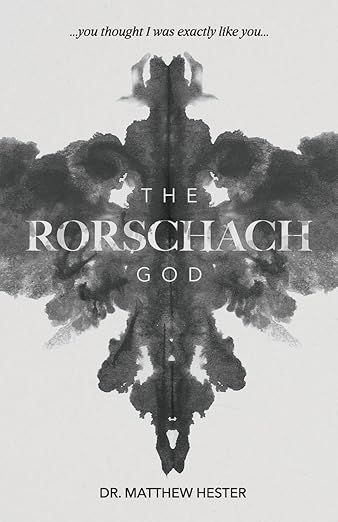
Full chapter adapted from Matthew Hester, The Rorschach God: You Thought I Was Exactly Like You . . . (Sanford, FL: Unorthodox Resources, 2024).
Join the Conversation
Receive thought-provoking articles that challenge conventional thinking, delivered to your inbox every week.
No spam. Unsubscribe anytime.

Dr. Matthew Hester
Dr. Matthew Hester has poured over two decades into various church and ministry roles. Beyond the pulpit, Matthew is a prolific author, having penned five books. Matthew is the host of both The Kingdom Is For Everyone Podcast and The Kingdom Is For Everyone television show, where he shares valuable spiritual teachings around all things righteousness, peace, and joy. Matthew founded the Present Truth Academy (P.T.A.), an online school dedicated to providing cutting-edge teachings from a diverse range of global thought leaders (www.PresentTruthAcademy.org). Matthew shares his life with his wife Megan and their four children.
Comments
We'd love to hear from you.
Create a free account or sign in to join the conversation — it only takes a couple of clicks.
Sign In / Create AccountNo comments yet. Be the first to share your thoughts.